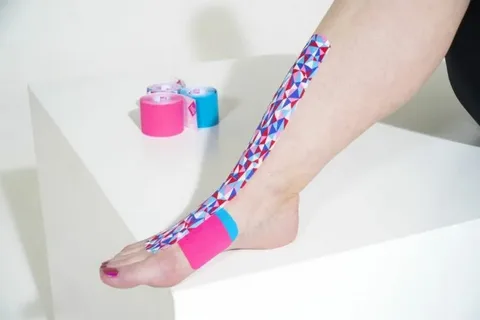
Kinesio Taping: More Than Just Colored Tape
Since its introduction in the 1970s by Japanese chiropractor Dr. Kenso Kase, kinesio taping—an elastic therapeutic taping method—has moved from the clinic into the public eye, largely due to its high-profile use by athletes during major sporting events like the Olympics.
More than just a colorful accessory, the kinesio taping method is designed to provide dynamic support and facilitate the body’s natural healing process without restricting the range of motion.
Unlike traditional athletic tape, which is rigid and used primarily to immobilize joints, kinesio taping (KT) uses a cotton-based, latex-free tape with an elasticity similar to human skin.
When applied, the tape lifts the skin microscopically, creating convolutions that are believed to influence the body’s physiological systems.
The Proposed Mechanisms of Kinesio Taping
The proposed benefits of kinesio taping stem from its interaction with the skin and underlying tissues. While clinical evidence remains mixed, the theoretical mechanisms of action are compelling and form the basis of its widespread use in rehabilitation and sports medicine.
- Modulating Pain Signals: The elastic tape is thought to stimulate sensory receptors in the skin, a process known as proprioception. This input may change the information your sensory nervous system sends to the brain about pain and compression. In a 2021 cross-sectional survey of healthcare professionals in the United States, 67% of respondents reported using KT for pain modulation, and 60% believed it works by modulating pain.
- Improving Circulation and Lymphatic Drainage: The microscopic lifting of the skin creates more space in the interstitial area below the tape. This change in pressure is hypothesized to enhance the flow of lymphatic fluid and blood, aiding in the removal of metabolic waste and reducing localized swelling and edema. This mechanism is particularly valued for accelerating the healing process after acute injuries.
- Providing Functional Support to Muscles and Joints: The tape’s elasticity can be used to either facilitate or inhibit muscle contraction, depending on the application technique. When applied from muscle origin to insertion, it may provide support to weakened muscles. Conversely, applying it from insertion to origin can help to inhibit overused or strained muscles. For joints, KT offers support while still permitting a full range of motion. For instance, studies suggest that for athletes with chronic ankle instability, kinesio taping provides a moderate stabilizing effect.
- Enhancing Proprioception and Muscle Re-education: The constant sensory feedback from the tape serves as a reminder for the body to maintain proper posture or movement patterns. Physical therapists often use KT to help “re-train” muscles that have lost function or gotten used to an unhealthy way of working, enhancing the brain’s sense of where the body is and what it is doing—proprioception.
Clinical Applications and Current Research
Kinesio taping is not typically used as a standalone treatment but rather as an adjunct therapy within a comprehensive rehabilitation plan. The American Physical Therapy Association (APTA) suggests that therapeutic taping is most effective when used in conjunction with other treatments, like manual therapy or exercise.
- Injury Treatment: It is commonly integrated into treatment plans for various musculoskeletal conditions, including Achilles tendonitis, patellofemoral stress syndrome, and shin splints. The 2021 survey of US healthcare professionals found that 74% used KT for post-injury treatment.
- Performance and Prevention: Some athletes use KT to provide extra support to vulnerable areas during competition or training, hoping to enhance performance or guard against injury. However, the scientific evidence to support the use of kinesio taping for performance enhancement in healthy individuals is largely inconclusive.
- Swelling Management: One of the more supported uses is for reducing swelling. Specific techniques, like the fan-shaped lymphatic drainage technique, are designed to maximize the lifting effect and improve fluid movement.
The Importance of Proper Application
The effectiveness of kinesio taping is highly dependent on the technique, including the direction of the application, the shape of the cut (e.g., I-strip, Y-strip, Fan), and the tension applied.
- The most common tape tension lengths used by surveyed US healthcare professionals were 50% tension (47%) and 25% tension (25%).
- It is generally recommended that individuals consult a qualified professional, such as a physical therapist or certified athletic trainer, for correct application to ensure the intended therapeutic effect.
While the scientific body of research for kinesio taping is often characterized by mixed and inconclusive results—with some studies suggesting a significant placebo effect—its popularity and clinical use continue to grow.
Many practitioners and patients report perceived benefits, and as an intervention, it is non-invasive, simple to apply, and non-restrictive.
The average recommended time to wear KT among professionals is two to three days, but it should be removed sooner if skin irritation occurs.